We provide tree pruning throughout the HD6 and HX3 postcode districts of Brighouse, from Clifton to Hipperholme, and in nearby Elland, Halifax and Cleckheaton. We check for tree preservation orders and conservation areas before work starts anywhere in Brighouse, and submit any notice needed on your behalf.
Garden trees in Brighouse are pruned for one of three reasons: to shape a young tree so it grows well, to bring a mature tree back within the space available, or to remove dead and dangerous wood. Brighouse Landscaping & Driveways carries out all three for homeowners, landlords and managing agents, from a single apple tree in a terrace back garden to the mature oaks and limes on larger plots.
Pruning is where more trees are ruined than anywhere else. A tree lopped back to stubs responds with a thicket of weak shoots that are far more likely to fail. A tree cut at the wrong time bleeds sap or opens itself to disease. We follow BS 3998, the British Standard for tree work, which sets out how and where to cut so the tree seals the wound and stays healthy.
Before any work starts we check whether the tree is covered by a tree preservation order or stands in a conservation area, both of which require an application or notice to the council. We handle that paperwork for you. Where a tree is beyond pruning, our Tree Removal service takes over, and hedges and ornamental shrubs are dealt with under Hedge and Shrub Maintenance.
Where We Offer Formative Tree Pruning
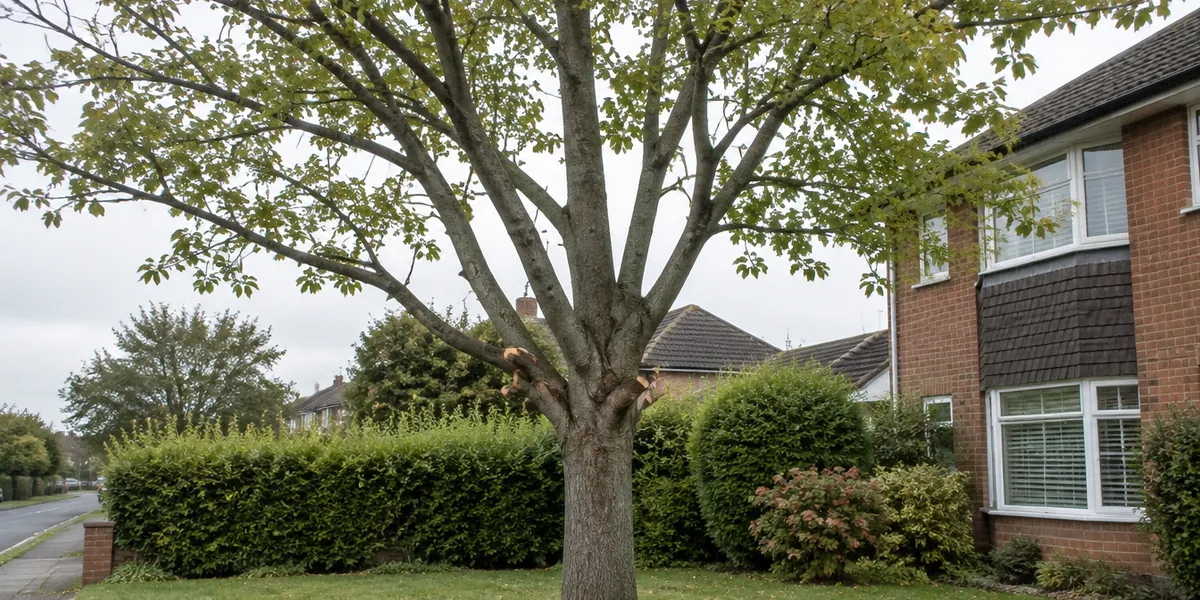
Formative pruning is the shaping of a young tree in its first few years so that it develops a strong framework and does not need heavy surgery later. It is the cheapest tree work there is and the most neglected. A tree planted in a Brighouse garden and left alone for a decade often ends up with a double leader, crossing branches and a crown too low to walk beneath.
The aim is a single straight leader, a clear stem to the height you want, and well-spaced main branches with wide angles to the trunk. Narrow forks with bark trapped between them tend to split as the tree gains weight, so we remove the weaker of any pair while they are still pencil-thick. Crossing branches come out before they wound each other. Low branches are removed gradually over several seasons, since leaves on the lower stem feed the trunk while it thickens.
Cuts are small and heal within a season. We cut just outside the branch collar, never flush with the trunk, and never leave a stub. On fruit trees the added aim is an open centre that lets light and air reach the fruit.
Timing depends on the species. Most deciduous trees are formatively pruned in late winter while dormant. Cherries, plums and other prunus are done in summer to avoid silver leaf. Birch, maple and walnut bleed if cut in late winter, so we leave those until midsummer. A visit every year or two for the first five years sets a tree up for life.
Crown Reduction
Crown reduction reduces the size of a tree's canopy while keeping its natural shape. It is the right choice when a mature tree has outgrown a Brighouse garden, is shading the house or a neighbour's windows, or needs its weight reduced because of a defect in the trunk. It is not topping, which cuts branches to stubs regardless of structure and causes most ugly, unsafe trees.
A proper reduction shortens each branch back to a suitable side branch that is at least a third of the diameter of the part removed. The tree is left with a smaller but complete canopy that continues to grow naturally. We specify the reduction in metres, for instance 1.5 metres on the sides and 2 metres on top, rather than as a percentage, so you know what to expect and the council knows what has been applied for.
The work is carried out from the ground with pole saws on smaller trees, and by rope and harness on larger ones. We do not use spikes on a tree that is staying, because every spike wound is an entry point for decay. We avoid removing more than is necessary in one visit, because a heavy reduction stresses the tree and provokes vigorous regrowth.
Most broadleaf trees can be reduced in winter or late summer. We avoid the spring flush, and we check for nesting birds between March and August before any work begins. A reduced tree will need repeating every few years to hold its size.
Deadwood Removal
Dead branches are not a problem for the tree, which has already sealed them off, but they are a problem for whatever is beneath them. A dead limb the thickness of an arm dropping from a mature oak onto a car, a shed or a path in Brighouse causes real damage, and as the owner of the tree you are responsible for it. Deadwood removal takes out that risk while leaving the living tree untouched.
We assess the tree from the ground first, looking for bark loss, fungal brackets, hanging limbs and branches with no leaves when the rest of the tree is in growth. Small deadwood of finger thickness is usually left, because it supports insects and birds and drops harmlessly. Anything larger over a target, meaning a house, path, parking space, play area or neighbour's garden, is removed.
The work is done by climbing with rope and harness, or with a pole saw where the deadwood is within reach. Each branch is cut back to the collar at its junction with living wood. Larger limbs are lowered on ropes rather than dropped. We take particular care over oak, beech and horse chestnut, which shed dead limbs without warning in hot, still weather.
Deadwooding can be done at any time of year, though dead branches are easier to spot when the tree is in leaf. Many of our customers in Brighouse have it done every two or three years as a routine inspection, and we report anything that suggests a deeper problem, such as fungal decay at the base.
What You Get When We Handle Your Tree Pruning
Bad pruning is permanent. A topped or flush-cut tree carries the damage for life, and the weak regrowth makes it more dangerous. Our team prunes to BS 3998, climbing and chainsaw work is done by NPTC-qualified operatives, and we know which species to cut when. We would rather talk you out of unnecessary work than take your money for it.
We check for tree preservation orders and conservation area status before quoting and handle the council application or notice on your behalf. We are insured for tree work at height, and our quote states exactly what will be done, in metres, so that there is no argument afterwards about how much came off. Arisings are chipped on site or removed under our registered waste carrier licence, and logs can be left for you if you want them.
Our pruning carries a written guarantee, and because we are based in Brighouse we can come back and look at a tree that is not responding as expected without a long wait.
Our Tree Pruning Process
- Site visit: we inspect the tree from the ground, note its species, condition, targets beneath it and any defects, and talk through what you want to achieve.
- Constraints check: we check the council register for tree preservation orders and conservation areas and tell you what consent is needed.
- Written specification and quote: you receive a clear description of the work, with reductions given in metres and a fixed price.
- Council application: where consent is required, we submit the application or notice and wait for the decision before starting.
- Nesting bird check: between March and August we inspect for active nests before any cutting begins.
- The work: the tree is pruned from the ground or by rope and harness, with limbs lowered under control and every cut made to the branch collar.
- Clearance: brash is chipped, logs are stacked or removed, and the garden is left tidy.
For trees in Brighouse that need regular attention we offer a return visit every two to three years so that the work stays light and the tree stays in shape.
How Tree Pruning Is Priced in Brighouse
The size of the tree is the main factor, since a mature lime requires a climbing team for most of a day while a young rowan takes an hour from the ground. The extent of the work follows: a light crown reduction costs less than a heavy one, and removing a few dead limbs is quicker than reshaping the whole canopy.
Access shapes the price in Brighouse more than most people expect. A front garden tree where the chipper can park on the drive is straightforward. A tree at the far end of a rear garden with no side access means every branch is carried through the house or over a fence by hand. Trees close to buildings, conservatories, greenhouses or overhead lines need rigging and controlled lowering, which takes longer.
Species matters, because some trees are harder to climb or produce more arisings. Disposal depends on volume and whether you keep the logs and chip. The written quote breaks all of this down.
Tree Pruning Around Brighouse
We prune garden trees throughout Brighouse. In Rastrick, if your mature tree is under a preservation order, we make the council application and carry out a careful reduction. In Hipperholme and Bailiff Bridge a common job is bringing an overgrown cherry, magnolia or apple back to a sensible size for a smaller garden. In Clifton, if your trees were planted with the house, they may now be due for formative pruning, while on a large plot in Lightcliffe with mature oaks or beeches, deadwooding is a regular call. We also travel to nearby Elland, Halifax and Cleckheaton.
Customers in Brighouse often ask us about tree and shrub care and tree removal at the same time.
Your Questions Answered
Do I need permission to prune a tree in my Brighouse garden?
Only if the tree is protected by a tree preservation order or your property is in a conservation area. In the first case you need council consent before work; in the second you must give the council six weeks' notice. We check the register for you before quoting and submit any application or notice on your behalf. Unprotected trees on private land can be pruned without permission.
When is the best time of year to prune trees?
Most deciduous trees are best pruned in late winter while dormant. Cherries, plums and other prunus should be cut in summer to avoid silver leaf. Birch, maple and walnut bleed sap in late winter, so we leave them until midsummer. Deadwood can be removed at any time. Between March and August we check for nesting birds before starting.
What is the difference between crown reduction and topping?
Crown reduction shortens branches back to suitable side branches so the tree keeps a natural shape and healthy structure. Topping cuts branches to stubs regardless of where they are, which produces weak, fast-growing shoots and large decaying wounds. Topping is not recommended under BS 3998 and we do not do it.
Can you prune a neighbour's tree that overhangs my garden?
You are entitled to cut back branches that cross your boundary, up to the boundary line, unless the tree is protected. The cut material belongs to the tree's owner and should be offered back. We advise telling the neighbour first, and we check for preservation orders and conservation area status before touching anything, because those restrictions apply regardless of whose side the branches are on.
What happens to the branches and logs?
Brash is chipped on site and either left for you as mulch or removed. Logs are cut to a length you can handle and stacked if you want firewood, or taken away. Anything we remove goes to a licensed facility under our registered waste carrier licence. We leave the garden swept and tidy at the end of the day.