We take on hedge and shrub maintenance right across Brighouse and its HD6 and HX3 postcodes, from Rastrick and Lightcliffe to Hipperholme, plus nearby Elland, Halifax and Cleckheaton. Before any cutting we check the local planning authority's records for tree preservation orders and conservation areas, and handle any notice or application for you.
Hedges and shrubs do the structural work in a garden. They mark the boundary, screen the road and hold the borders together through winter. They also grow, and in Brighouse a privet or laurel hedge left for two seasons will be a metre wider and blocking the path. Brighouse Landscaping & Driveways offers a hedge and shrub maintenance service that keeps all of this in order for homeowners, landlords and businesses who want it done well and on time.
The service has three parts. Hedge trimming keeps formal and informal hedges to size and shape, cut at the right time for the species. Shrub rejuvenation pruning brings overgrown, leggy or tired shrubs back to health through planned hard pruning. Topiary maintenance clips box, yew, bay and other shaped plants to keep their lines sharp. All clippings are removed under our registered waste carrier licence.
We work across Brighouse on single visits and on an annual schedule. Where the plant in question is a tree rather than a shrub, our Tree Pruning service applies, and a hedge that has to come out altogether, or a dead conifer screen, falls under Tree Removal.
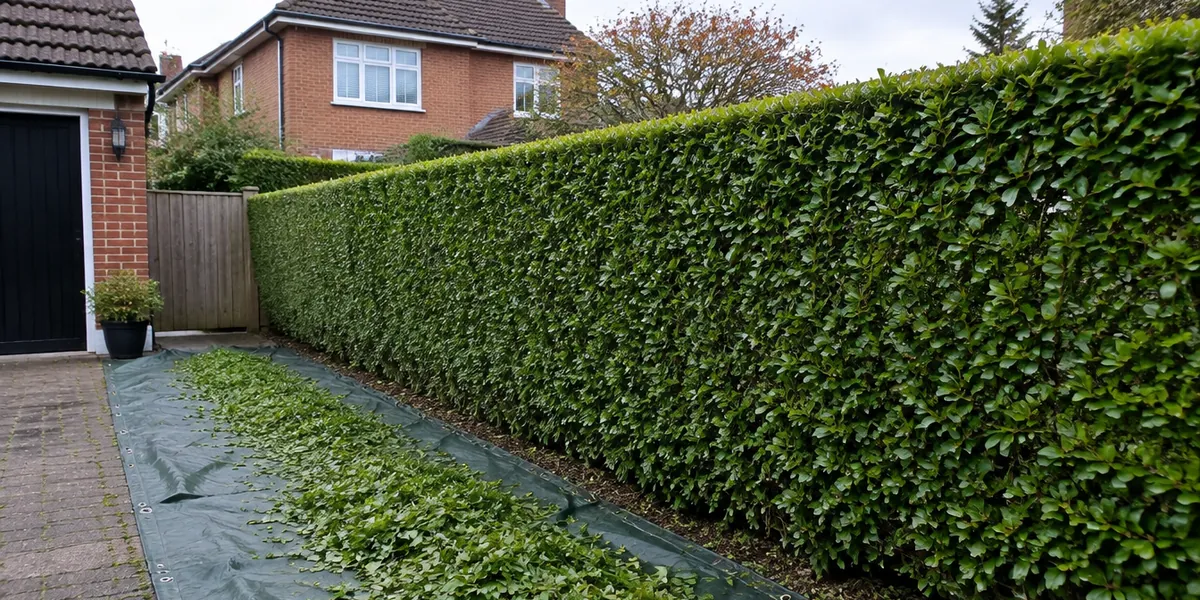
Hedge Trimming
A hedge is only as good as its last cut. Trimmed at the right time with sharp blades it stays dense, green to the base and the width you want. Cut badly, or too late, it goes bare at the bottom and spreads. We trim hedges of every size in Brighouse, from a knee-high box edging to a six-metre leylandii screen worked from a platform.
Species sets the timing. Formal evergreens such as privet, box, yew and laurel are cut two or three times between late May and September, with the final trim early enough for regrowth to harden before frost. Conifers including leylandii are cut once or twice in summer and never back into brown wood, which will not regrow. Beech and hornbeam get a single cut in late summer. Flowering hedges, from forsythia to escallonia, are cut straight after flowering.
Between March and August we check carefully for nesting birds before cutting, and if we find an active nest we come back when it is empty.
Shape matters as well as timing. We cut a formal hedge slightly narrower at the top than the base, with a batter of a few degrees, so light reaches the lower growth and it stays leafy to the ground. Lines are set with string. Arisings are raked from the beds and lawn, the paths are blown clear and the clippings leave with us. Where a hedge has got too wide, we suggest a staged reduction over two seasons rather than one brutal cut.
Shrub Rejuvenation Pruning
Many garden shrubs were planted decades ago and have been trimmed over the top with a hedge cutter ever since. The result is a tall, woody framework with a thin skin of leaves at the top and nothing beneath. Rejuvenation pruning is the planned hard pruning that brings these plants back to a compact, vigorous and flowering state.
Many common shrubs respond well. Philadelphus, deutzia, weigela, forsythia, lilac, dogwood, hazel, elder, cotinus, spiraea and most viburnums can be cut back hard and will regrow from the base. Evergreens such as laurel, aucuba, elaeagnus, holly, yew, box and camellia tolerate it too. Some do not: most conifers, lavender, cistus, ceanothus and broom will not regrow from old wood, and we tell you honestly when the better answer is replacement.
There are two methods. The gentler one removes a third of the oldest stems at ground level each year for three years, so the shrub is renewed without losing all its flowers. The harder one takes the whole plant down to 150 to 300 mm in one go, which is quicker but means a season or two without flowers. We choose based on the species and how overgrown the plant is.
The work is done in late winter for most deciduous shrubs and in spring for evergreens, once the hardest frosts have passed. We follow the cut with a balanced feed, a mulch of compost and watering in a dry spring. The regrowth is thinned the following year to select the best new stems.
Topiary Maintenance
Topiary makes a small front garden in Brighouse look considered. It also needs clipping two or three times a year by someone with a steady hand, because a lopsided ball is noticed by everyone who walks past. Our team maintains box, yew, holly, bay, privet, lonicera and Ilex crenata topiary in all the usual forms: balls, cones, spirals, cubes, cloud-pruned specimens and standards.
The first clip of the year is in late May or early June once the spring growth has hardened, followed by a second in late summer. Yew usually needs only one cut in August. We clip with sharp hand shears for most shapes, because they avoid the bruised, browned leaves that blunt blades leave on box. Spirals are cut with single-handed sheep shears. Templates and canes keep spheres and cones true.
Box in Brighouse has two particular enemies: box blight and box tree caterpillar. We inspect every box plant on each visit, clip in dry weather so wounds seal quickly, clean our shears between plants and clear every fallen leaf from beneath the specimen. Caterpillar is treated with a biological spray from April. Where blight is established, we discuss whether to persist or replace the plant with a resistant alternative such as Ilex crenata or Euonymus japonicus.
Topiary in pots is fed with a liquid feed through summer and top-dressed every couple of years, and specimens in the ground get a spring feed and mulch so they recover quickly from each clip.
What You Get When We Handle Your Hedge and Shrub Maintenance
Anyone can run a hedge trimmer along a privet. Fewer people know that cutting a conifer into brown wood kills it, that a philadelphus flowers on last year's growth, or that box clipped in wet weather invites blight. Our team does, and that is the difference between a garden that improves each year and one that slowly deteriorates.
We quote in writing, with the timing of each cut set out so you know when to expect us. Tall hedges are worked from platforms or ladders with proper footing, and we are insured for work at height. Nesting birds are checked for every visit in season. All clippings are removed under our registered waste carrier licence, and we never leave piles on the verge for the council.
Our work comes with a written guarantee, and since we are based in Brighouse we can fit a hedge into the right fortnight rather than whenever a van happens to be passing.
Hedge and Shrub Maintenance: Step by Step
- Site visit: we identify each hedge and shrub, assess its condition and age and discuss the shape and size you want.
- Written schedule and quote: you receive a plan showing which plants are cut in which months, any rejuvenation work proposed and a fixed price.
- Nesting check: before any cutting between March and August we inspect for active nests and postpone that section if we find one.
- Hedge trimming: lines are set with string, the hedge is cut with a slight batter and sharp blades, and corners and tops are finished by hand.
- Rejuvenation and topiary: hard pruning is carried out at the right season for each species, and shaped plants are clipped with shears and templates.
- Aftercare: pruned shrubs are fed, mulched and watered where needed so they recover quickly.
- Clearance: clippings are raked from beds and lawns, paths are blown clean and the waste leaves with us.
For gardens in Brighouse with a lot of hedging we recommend an annual contract so the cuts happen at the right time without you having to remember to book.
What Affects the Cost of Hedge and Shrub Maintenance in Brighouse
Hedge length, height and width drive the labour. A 20-metre privet at head height is a quick job; a 40-metre leylandii at five metres needs a platform, two people and a day. How overgrown the hedge is matters too, since cutting back hard produces far more arisings and takes longer than a light trim of regular growth.
Species plays a part. Fast growers such as privet and leylandii need more cuts a year than yew or hornbeam. Topiary is priced by the number and complexity of pieces, because a spiral takes several times longer than a ball. Rejuvenation pruning is quoted per shrub and depends on size and the method chosen.
Access in Brighouse affects everything: hedges that back onto a road may need traffic cones, and rear gardens reached through the house mean every bag of clippings is carried by hand. Disposal is charged by volume. The written quote sets out each hedge and shrub separately.
Hedge and Shrub Maintenance Across Brighouse
We maintain hedges and shrubs in every part of Brighouse. In Rastrick, if you have a long boundary hedge of mature yew, beech or laurel, it rewards a careful annual cut. In Hipperholme we cut a great deal of front-garden privet and box topiary, where sharp lines matter because the street sees them. In Bailiff Bridge, if your shrub borders are overgrown from a previous generation of planting, they are ideal for rejuvenation work. If your home in Clifton is on a newer estate with a fast-growing conifer screen, we keep it in check, and if you have a larger garden in Lightcliffe with mixed hedging and specimen topiary, we look after both. We also cover nearby Elland, Halifax and Cleckheaton.
Other work we carry out across Brighouse include tree and shrub care and tree pruning.
Common Questions
When should hedges be cut in Brighouse?
Formal evergreen hedges such as privet, box and laurel are trimmed two or three times between late May and early September. Conifers are cut once or twice in summer. Beech and hornbeam get one cut in late summer. Flowering hedges are cut straight after they flower. We avoid cutting during the nesting season unless we have checked the hedge and found no active nests.
Can an overgrown leylandii hedge be cut back hard?
Not safely. Leylandii and most conifers will not regrow from brown wood, so a hedge cut back beyond the green growth stays bare. We can reduce the height considerably, because the top will regrow, and take the sides back to the inner edge of the green, but a conifer that has been let go for years often cannot be returned to a narrow hedge. Replacement is sometimes the honest answer.
Is there a legal height limit for hedges?
There is no automatic limit, but under the high hedges legislation a neighbour can complain to the council about an evergreen hedge over two metres that affects their enjoyment of their property, and the council can order it reduced. Keeping a boundary hedge at a reasonable height avoids the dispute. We also check nesting birds and any conservation area restrictions before cutting.
My shrubs are leggy with flowers only at the top. Can they be saved?
Usually, yes. Most deciduous shrubs and many evergreens regrow strongly when cut back hard in late winter or spring. We either remove a third of the oldest stems each year for three years, which keeps some flowers, or cut the whole plant down at once for a faster result. Conifers, lavender, cistus and ceanothus do not regrow from old wood, and for those we suggest replacement.
How often does topiary need clipping?
Box and most other topiary is clipped twice a year, in late May or June and again in late summer, with a third light clip for very formal pieces. Yew needs only one cut in August. We clip in dry weather with sharp hand shears, clear fallen leaves from beneath the plant and check for box blight and box tree caterpillar on every visit.